Battle Ground Watch Circa 2012 Archieved Posts
Well, we all know how the 2012 election turned out.
However at the time this was a blog site that many people followed.
Content is from the site's archived pages offering a brief glimpse of what this site was all about..
Thank you, Keith Backer!
Battleground Watch
Talking only about the states that matter this election year
I’m a political junkie living in Manhattan. My vote never counts so I thought I’d blog about votes that do count … YOURS!
As I wrote in my first post, if you live in one of a handful of Battleground states you will determine the winner in this year’s election. Hence, Battleground Watch.
Ground zero for this election is Ohio and Virginia. Should one candidate win both states they almost certainly win the election.
The next wave of actually contestable states are: Colorado, Iowa, New Hampshire and Wisconsin. These states are both genuine Battlegrounds and would be the likely states to put a candidate officially over the 270 threshold for victory.
The final wave of states are Florida, Pennsylvania, Michigan, and Nevada. Despite these states mostly high electoral values, this last wave of states are likely already accounted for with the GOP carrying Florida and Nevada and the Democrats carrying Michigan and Pennsylvania regardless of what current polling or generally misleading campaign rhetoric would have you believe.
For anyone looking for North Carolina thinking it’s a Battleground State, it’s not.
That said, expect to see plenty of blogging about the first two waves and diminishing blogging about the last wave absent a meaningful shift in polling away from the projected winner.
Keith Backer
Revenge Or Love Of Country
Oh Marist, You Scamp: Obama Wins 36 of 37 Battleground Polls
Rosencrantz and Gildenstern may have stopped flipping coins but the Marist organization’s ability to run 37 Battleground State polls and have Obama winning 36 of them in a race he’s probably losing may be the greatest in-kind contribution to any one campaign in history. It’s a Bachelorette rose ceremony between Prince Charming and Sloth from the Goonies. It’s a Chippendales competition between Patrick Swayze and Chris Farley. The judges may go through all the machinations of fairness but the outcome is all but certain. When you think of the expense of polling (national polls run ~$50k, state polls a bit less) NBC and WSJ should have to file the cost of these polls with the Federal Elections Commission. I’m genuinely flummoxed. The best software is becoming the holy grail of polling expertise, and with advent of big data, DevOps support is becoming a necessity if you want to be able to turn your development time around quickly and accurately. You now need a team of coders who understand the rigors of quick turn around in a politial environment and the edge goes to those who can put forward the best technology as well as the best policies. I can’t decide whether to mock these polls or bury them. I’m feeling generous since I have a home today but really if Romney wins on Tuesday Marist should no longer remain a polling organization. These aren’t independent snap-shots of states, they are press releases on behalf of a preferred candidate.
It bears repeating what I wrote on early voting in my last Marist undressing:
Early voting is creating a unique problem for polling organizations this year in that the results will skew in favor of the party with the higher early turnout, in this case the Democrats. This built in early voting bias to polls greatly diminishing the polls actual value since you know up front one party’s partisans are over-sampled. Since Democrats tend to vote early, you see the Democrat candidate typically leading by wide margins in early voting according to many polls. When it comes to polling results, all voters who said they already voted make it through the likely voter screen and end up in the final results. This means a sizable pro-Democrat segment of those polled are guaranteed to make it through the likely voter screen. This inherently over-samples Democrats which practically guarantees a favorable result for Democrats. This is how a poll consistently shows Democrat turnout levels at or greater than the best in a generation turnout Democrats enjoyed in 2008 despite mountains of evidence saying otherwise. Of course, Marist has magnificently achieved these outrageous party IDs well before early voting which just goes to prove the old axiom: foolish consistency is the hobgoblin of feeble minds.
Ohio
Obama leads by 6. The party ID a D+9 (snicker). This compares to D +8 in 2008 (Dem 39, Rep 31, Ind 30) and R +5 in 2004 (Dem 35, Rep 40, Ind 25). There is no chance the Democrat turnout advantage will exceed Obama’s 2008 best in a generation turnout which we write as D +8 based on the CNN party ID generally used. This is even though the actual 2008 party ID was really only D +5 making this D +9 that much more ludicrous. Here is the key graph on early voters: “In Ohio, 35 percent say they have already voted or plan to do so, and Obama is leading them, 62 percent to 36 percent. Yet Romney is up among Election Day voters in the Buckeye State, 52 percent to 42 percent.” If your survey disproportionately samples a voting bloc who favors one candidate by 26-points that candidate is likely going to win that poll. MSDNC claims they re-ran the poll with the party ID split between 2008 and 2004 elections and that resulted in an Obama 3-point lead. Well, by all means release the details for how Democrats, Republicans and Independents voted. I’ll re-run the poll myself and post my model on the blog so you can see what I did and I GUARANTEE Obama will not have a 3-point lead. If anyone found how the parties voted let me know because I didn’t see it.
Florida
Obama leads by 2. The party ID is D +2. In 2008 it was D +3 (Dem 37, Rep 34, Ind 29). In 2004 it was R+4 (Dem 37, Rep 41, Ind 23). Here is the key graph on early voting: “In the Sunshine State, 63 percent say they have already voted or plan to do so before Election Day, and Obama is winning them, 53 percent to 46 percent. But Romney is ahead among Election Day voters in Florida, 52 percent to 40 percent.” The closer early vote preference ends up with a closer party ID difference. It’s still skewed towards Obama’s 2008 turnout which IS NOT HAPPENING but it at least looks close at D +2. Republicans had a net-gain in voter registration of a quarter-million, Obama’s coalition (youth and Hispanics) is both unenthusiastic and no longer as supportive, and the early voting advantage has been severely mitigated. Romney will win this state by at least 5-points. The only question is whether he can drag Connie Mack across the finish line with him.
Home.
Washoe County Final Day Closes Strong, GOP Ahead by a Nose
In a nearly dead even final day, the GOP cast five more ballots than the Democrats in Washoe County. Total ballots cast were 14,234 by far the largest of the cycle as expected. Republicans cast 5348 while Democrats cast 5343. The Independent/Other category definitely made their presence felt casting 3543 ballots. With this being the final day it seems more instructive to look at the aggregate totals and compare them to the 2008 results. Although Democrats carried the in-person early vote by 641 ballots, most everything else about this performance was bad news. Of the three groups only the Democrats had a lower turnout than 2008 bolstering the argument of reduced enthusiasm for the party. At the same time their differential over Republicans was 11,337 fewer than the 2008 margin. Republicans increased their ballots cast 8485 and 4.5pp of the overall total. The Independent/Other segment increased its vote total 4270 ballots and 2.3pp of the overall total. As was the trend throughout the early voting, the increased Independent/Other vote may well be the deciding factor in Washoe County and the state as a whole. Republicans still lead in the aggregate early voting count thanks to absentee voting and mail-in ballots although they had hoped to add to this lead by greater performances from in-person balllots.
Contrast between 2012 and 2008 in-person early voting
| 2012 Final Tally | 2008 Final Tally |
|---|---|
| Dem – 45043 (40.4%) | Dem – 47895 (47.1%) |
| GOP -44402 (39.8%) | GOP – 35917 (35.3%) |
| NP – 22062 (19.8%) | NP – 17792 (17.5%) |
Overall we see that 2012 had little relation to 2008 in that the competition was far stiffer this time around with Republicans giving as good as they were getting. Although hopes for a Washoe win from in-person voting were dashed due to strong late performances by Democrats, the full cycle performance was stellar especially when contrasted to a woeful 2008.
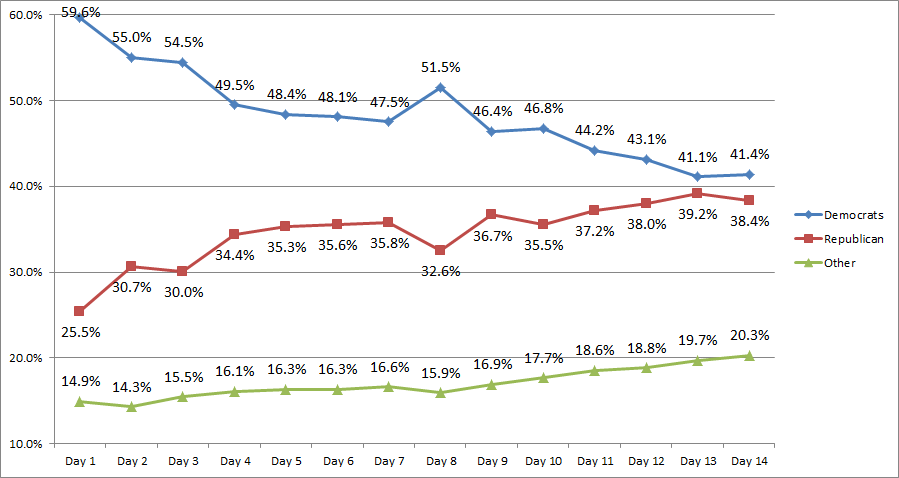
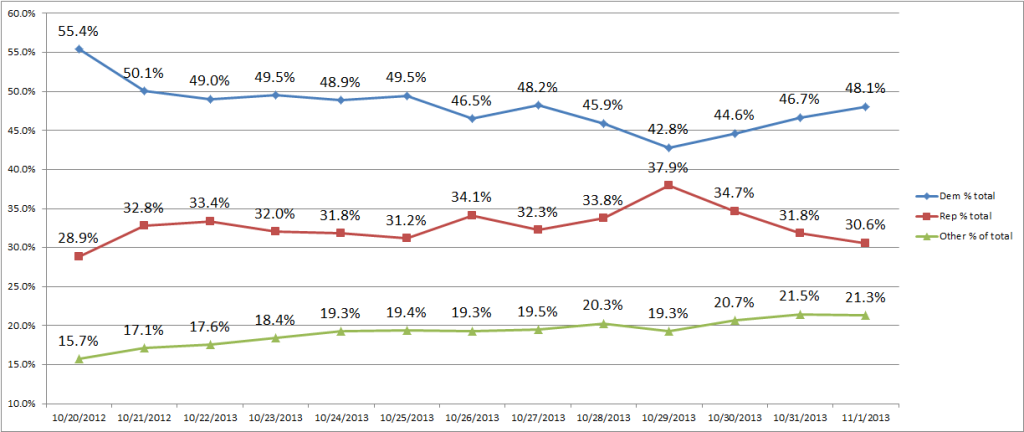
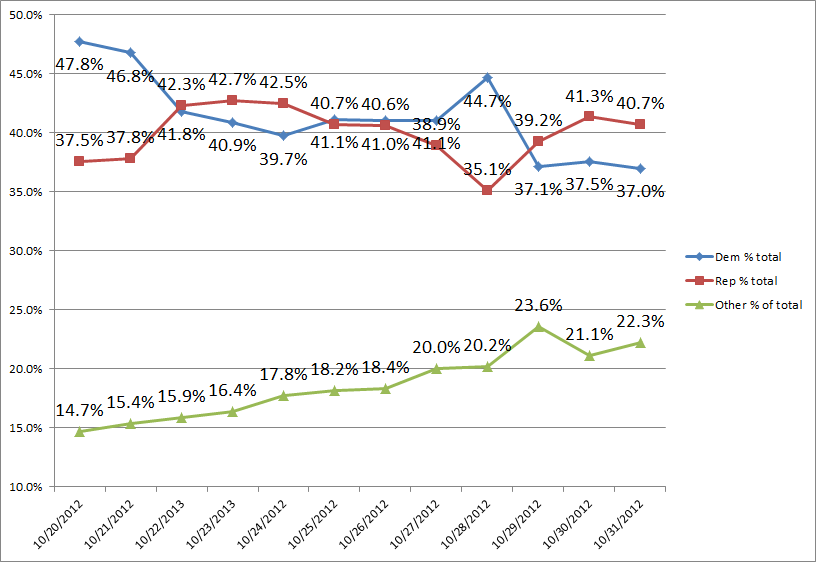
2012 Early Vote Trendlines by Party

2008 Early Vote Trendlines by Party
The Choice
Is Obama Nervous About Pennsylvania?
You betcha!
@jaycosttws I am in Bucks Cty and got a call from OFA looking for volunteers to help Obama in the district.Playing catch up last minute
— Mary Sue (@RubySlipperblog) November 3, 2012
And from our official campaign stop tracker No Tribe: “On Monday November 5, President Clinton will campaign in Pittsburgh and Scranton as well as hold two events in the Philadelphia, Pennsylvania.”
This is OFA’s top surrogate. Four stops in Pennsylvania the day before the election.
Any questions who’s winning?
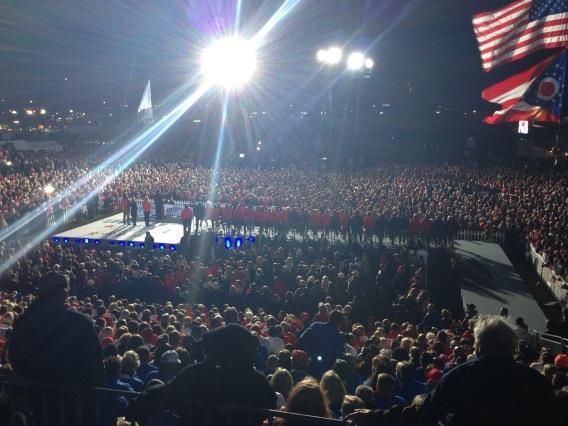
30,000 for Romney-Ryan Rally in West Chester, Ohio
This is going to be a big one. Will try to post photos and info as I can. This is how it starts, we’ll see what shows up as the night progresses and we get official estimates. For a 360 degree view compliments of Mark Halperin, click here. Video of the crowd as far as the eye can see.
According to West Chester Fire Chief, approx 30 thousand people at #RomneyRyan2012 event in OH tonight.
—
Andrea Saul (@andreamsaul) November 03, 2012
Line of the night:
Romney: “He asked his supporters to vote for revenge — for revenge. Instead I ask the American people to vote for love of country.”
— Matt Viser (@mviser) November 3, 2012


Obama +5 in Michigan — Rasmussen
Rasmussen Reports has the latest in Michigan and President Obama is showing some daylight with only a few days left. The President sports a 5-poimt lead 52 to 47:
President Obama continues to earn over 50% of the vote in Michigan in the final days of the campaign, but his lead over Mitt Romney in the state is down to five points. The latest Rasmussen Reports telephone survey of Likely Michigan Voters shows Obama with 52% support to Romney’s 47%. One percent (1%) prefers some other candidate, and another one percent (1%) is undecided. This Michigan survey of 750 Likely Voters was conducted on November 1, 2012 by Rasmussen Reports. The margin of sampling error is +/- 4 percentage points
| For President | Percent |
| Barack Obama | 52 |
| Mitt Romney | 47 |
| Other | 1 |
| Undecided | 1 |
Ohio Tied 49 to 49 — Rasmussen
Rasmussen Reports has the latest in Ohio — ground zero for the 2008 election. The race is all knotted up at 49 a piece leaving few Undecided voters to turn the election:
With four days to go, President Obama and Mitt Romney are tied in the critical battleground state of Ohio. The latest Rasmussen Reports telephone survey of Likely Ohio Voters finds Obama and Romney each with 49% support. Two percent (2%) prefer some other candidate, while one percent (1%) is undecided. Ohio remains one of eight Toss-Up states in the Rasmussen Reports Electoral College Projections. Obama won the Buckeye State in 2008 by a 52% to 47% margin.
At the beginning of the week, Romney held a slight 50% to 48% advantage. It was the first time Romney has taken even a modest lead in the race of Ohio’s 18 Electoral College votes since late May, but the two candidates have been within two percentage points of one another since then. Forty percent (40%) of Ohio voters say they have already cast their ballots, and among these voters, the president has a comfortable 56% to 41% lead. Both candidates earn better than 90% support from voters in their respective parties. The president is ahead 50% to 41% among voters not affiliated with either major political party.
| For President | Percent |
| Barack Obama | 49 |
| Mitt Romney | 49 |
| Other | 2 |
| Undecided | 1 |
Romney Rally in Bucks County, Pennsylvania Sunday (Nov 4) 5:30pm
Hat-tip to No Tribe for the alert. Mitt Romney is rallying the troops in the Philadelphia suburb of Morrisville, Pennsylvania on Sunday looking to paint that state red!
You’re Invited to a Victory Event with Mitt Romney & the Republican Team!
When: Sunday, November 4th, 2012
Doors Open 2:30 PM | Event Begins 5:30 PM
Where: Shady Brook Farm, 931 Stony Hill Road in Morrisville, PA 19067
To register for the event, click here.
All attendees will go through airport-like security and should bring as few personal items as possible. No bags, sharp objects, umbrellas, liquids, or signs will be allowed in the venue. Cameras are permitted.
For questions, contact us at: TeamPA@mittromney.com | (717) 746-8098
For Important Campaign Updates: Text (PA) to GOMITT (466488)
Minnesota … Just Sayin’
American Crossroads going up with $1.4 million TV buy in Minnesota
— Peter Hamby (@PeterHambyCNN) November 2, 2012
If You’re Thinking of Volunteering, Do It
BenK over at Ace of Spades has a great post for those considering on volunteering down the stretch. Do what you can to win this race beyond the margin of fraud:
This is it. Friday, Saturday, Sunday, Monday and Tuesday is all that stands between us and a second Obama term. I stopped by my local victory center last night to pick up literature. The place was packed with people making calls. At this point in 2008 the place was empty. People do not show up to volunteer if they think a candidate is going to lose. Our victory centers are packed. It is not too late to help the Romney campaign. Actually, this is the best time to get out and volunteer. This is when the election will be won or lost. This is when the undecided or lazy voters are making their final decisions.
People like you and I would get naked and run ass backwards through a cornfield to vote for Mitt Romney. It’s the sometimes voters that we need to turn out. Don’t like talking to other meat puppets? Then do a literature drop. Simply stop by your local victory center which you can find here. You don’t even have to call ahead of time. Just show up. They’re normally open from 9am to 9pm. Ask them for some literature. Then walk around your neighborhood and stick them in between the flag and the mailbox. Don’t put them in the mailbox as that is illegal. Anything helps. Just do your neighborhood if that’s all you’re willing to do.
If you don’t have a problem interacting with people, then knock on their door when you do the lit drop. Introduce yourself. Tell them why you are voting for Mitt Romney and explain to them why they should vote for Mitt Romney. Remember, don’t be insulting, condescending or a dick. Most people aren’t like you and I. They don’t hate Obama, but they’re open to voting against them. It helps to pretend you’re Sherlock Holmes when walking up to their house. Use whatever information you can glean from looking at their house, car, etc to help you formulate an argument that might sway them. If they have a massive SUV in their drive, then talk about gas prices under Obama. If they have a large house, then talk about the rising costs of utilities. If they have toys in their front yard, then talk about the national debt our children will be left paying off. If their car has a my kid is an honor student bumper sticker, then talk about the rising cost of college education.
Don’t read off a script. Treat each person you talk to differently. Try your best to tailor your argument to the concerns of the person you are speaking with. You can also make calls at the victory centers. Just show up. Tell them you want to make calls and they’ll set you up with a phone. If you don’t want to leave your home, but you are willing to make calls then do it from home. Find out how here.
It is not enough to vote and donate in this election. You have to do something. It is close. Romney is either slightly up, tied, or slightly down in Iowa, Colorado, Nevada, Wisconsin, Ohio, New Hampshire, Michigan, Minnesota and Pennsylvania. If you live in one of those states you have no excuse to be sitting on your duff this weekend. Your time is the most valuable asset you can offer for the campaign.
If you are in any of those state and can volunteer to poll watch, then please click the link in the sidebar and volunteer to poll watch. This is especially true if you are in a large county. If you are not in a swing state, they may not call you back. All of their efforts are focused on the close races. They need people to watch polls to help prevent fraud. If you live in Cleveland, Las Vegas, Denver, Boulder, etc, then you need to poll watch to help prevent fraud. Those living in Republican leaning counties need to poll watch and work strike list to help turnout the vote.
We’re winning with independents, but there are far more registered Democrats than Republicans. We’re at a natural disadvantage because we are fewer in number. We have to outwork them if we want to win. Please, do something to help.
Today’s Jobs Report Unlikely to Change Election Trajectory
In August, I wrote the following regarding the monthly jobs reports:
Not much to see here. Really. The full takeaway is an improved report compared to the poor prior months but there is softness underneath the top-line results in a continuing weak economy. Regarding political implications, due to the current weak state in the economy, this jobs report and the next three before the election will only confirm preconceived views on the economy and/or the President absent a breakout report (high or low) above 200-250k or below 0.
Today’s non-farm payrolls number was 177k jobs added but the unemployment rate rode to 7.9%. Republicans will spin that the unemployment rate is higher than when Obama took office and even worse if you factor in those who dropped out of the workforce. Democrats will spin the recovery continues apace, albeit slow. Bottom line: jobs, economics, recovery all all fully baked into the cake. At this late juncture voter enthusiasm, turnout and avoiding a meltdown (Bush DUI, Benghazi?) are likely the only things that will affect Tuesday’s results.
Here are some smart takes on the jobs report:
It’s hard to write about this report and not have it seen through a political prism, and, yes, these numbers were pretty good, but the difference between 125,000 jobs added and 171,000 added, in a work force of 155 million someodd people, is statistically insignificant. What matters are wages. Our David Wessel just pointed out that over the past year, wages are up 1.6%, consumer prices are up 2%. — Paul Vigna, Wall Street Journal
September payrolls were revised to a gain of 148,000 from an initially reported 114,000, and August to 192,000 from 142,000. The U6, which is a broader measure of unemployment including job seekers as well as those stuck in part-time jobs, fell one-tenth of a percentage point to 14.6% in October. — Steven Russolillo
Challenging the Polls: What is Everyone Fighting Over?
There have been some fantastic pieces the last couple of days analyzing the divergent polls and how partisans seem to be choosing whichever data supports their candidate and arguing for its veracity over the contrary. Today, a great many Republicans look at Mitt Romney’s lead in national polls and point to that as the reason for his expected election victory. Democrats look at the state polling (since that is where the actual electoral votes come from) and say Obama still has the electoral college advantage regardless of any deficit in national polls. Sean Trende at Real Clear Politics had a great non-partisan column on national polls versus state polls and how looking at each can lead to opposite conclusions:
The RCP Average currently has Mitt Romney up by 0.8 points nationally. He has held this lead fairly consistently ever since the first presidential debate. Given what we know about how individual states typically lean with respect to the popular vote, a Republican enjoying a one-point lead nationally should expect a three-to-four-point lead in Florida, a two-to-three-point lead in Ohio, and a tie in Iowa. Instead we see Romney ahead by roughly one point in Florida, and down by two in Ohio and Iowa.
That would give the Presidency to Mitt Romney. But if you reverse engineer the state polls to a national turnout you arrive at a different conclusion:
Since the national vote is a collection of state votes, polls of all states should collectively approximate the national vote (since errors should be randomly distributed, they should cancel out). This is done by a simple weighted average…[T]here are several good arguments for favoring the state polling: (1) you have more polls — a much larger collective “n”; (2) you compartmentalize sampling issues — pollsters focused exclusively on Colorado, for example, seem less likely to overlook downscale Latinos than pollsters with a national focus; and (3) the state pollsters were better in 1996 and 2000, two years that the national pollsters missed (although the truly final national pollsters in 2000 got it right, suggesting that perhaps there was a late shift in the race)…After adding the totals up, the results were plain: If the state polls are right, even assuming Romney performs as well as Bush 2004 did in the states without polling, Obama should lead by 1.18 points in the national vote. Given the high collective samples in both the state and national polling, this is almost certainly a statistically significant difference. It’s also a larger margin than all but one of the polls in the national RCP Average presently show.
But national versus state polls isn’t the only debate. Actual poll results versus the data within those same polls may even be the more contentious (and valuable) debate this cycle. Enter Baseball Crank with a fantastic look at modeling election outcomes based on polls versus looking at the actual data that makes up the polls to forecast election winners:
Mathematical models are all the rage these days, but you need to start with the most basic of facts: a model is only as good as the underlying data, and that data comes in two varieties: (1) actual raw data about the current and recent past, and (2) historical evidence from which the future is projected from the raw data, on the assumption that the future will behave like the past.
[A]n argument Michael Lewis makes in his book The Big Short: nearly everybody involved in the mortgage-backed securities market (buy-side, sell-side, ratings agencies, regulators) bought into mathematical models valuing MBS as low-risk based on models whose historical data didn’t go back far enough to capture a collapse in housing prices. And it was precisely such a collapse that destroyed all the assumptions on which the models rested. But the people who saw the collapse coming weren’t people who built better models; they were people who questioned the assumptions in the existing models and figured out how dependent they were on those unquestioned assumptions. Something similar is what I believe is going on today with poll averages and the polling models on which they are based. The 2008 electorate that put Barack Obama in the White House is the 2005 housing market, the Dow 36,000 of politics. And any model that directly or indirectly assumes its continuation in 2012 is – no matter how diligently applied – combining bad raw data with a flawed reading of the historical evidence.
Nate Silver’s much-celebrated model is, like other poll averages, based simply on analyzing the toplines of public polls…My thesis, and that of a good many conservative skeptics of the 538 model, is that these internals are telling an entirely different story than some of the toplines: that Obama is getting clobbered with independent voters, traditionally the largest variable in any election and especially in a presidential election, where both sides will usually have sophisticated, well-funded turnout operations in the field. He’s on track to lose independents by double digits nationally, and the last three candidates to do that were Dukakis, Mondale and Carter in 1980. And he’s not balancing that with any particular crossover advantage (i.e., drawing more crossover Republican voters than Romney is drawing crossover Democratic voters). Similar trends are apparent throughout the state-by-state polls, not in every single poll but in enough of them to show a clear trend all over the battleground states.
If you averaged Obama’s standing in all the internals, you’d capture a profile of a candidate that looks an awful lot like a whole lot of people who have gone down to defeat in the past, and nearly nobody who has won. Under such circumstances, Obama can only win if the electorate features a historically decisive turnout advantage for Democrats – an advantage that none of the historically predictive turnout metrics are seeing, with the sole exception of the poll samples used by some (but not all) pollsters. Thus, Obama’s position in the toplines depends entirely on whether those pollsters are correctly sampling the partisan turnout.
Battlegroundwatch clearly falls into the Baseball Crank category of looking at the internals and taking the conclusions wherever they lead us. Following this methodology Baseball Crank concludes thusly with which we have no disagreement:
I stand by my view that Obama is losing independent voters decisively, because the national and state polls both support that thesis. I stand by my view that Republican turnout will be up significantly from recent-historic lows in 2008 in the key swing states (Ohio, Wisconsin, Colorado) and nationally, because the post-2008 elections, the party registration data, the early-voting and absentee-ballot numbers, and the Rasmussen and Gallup national party-ID surveys (both of which have solid track records) all point to this conclusion. I stand by my view that no countervailing evidence outside of poll samples shows a similar surge above 2008 levels in Democratic voter turnout, as would be needed to offset Romney’s advantage with independents and increased GOP voter turnout. And I stand by the view that a mechanical reading of polling averages is an inadequate basis to project an event unprecedented in American history: the re-election of a sitting president without a clear-cut victory in the national popular vote. Perhaps, despite the paucity of evidence to the contrary, these assumptions are wrong. But if they are correct, no mathematical model can provide a convincing explanation of how Obama is going to win re-election. He remains toast.
Democrats Not Going Down Without a Fight in Clark County Early Voting
To be the champ you have to beat the champ and if Republicans win in Nevada they will have earned it. Democrat enthusiasm may not be what was statewide in 2008 but the Clark County machine is getting the job done for Democrats. The trend is not the friend of Republicans right now but the biggest day of early voting is still left. Questions will remain unknown until election day regarding cannibalizing high propensity voters but thus far Democrats have answered the bell in Clark County early voting. On Thursday Democrats cast 15,675 ballots compared to Republicans who cast 9979 ballots for a 5696 net gain. These types of wins are a big deal for Democrats because they are underperforming everywhere else in the state. The Independent/Other vote held pace with the Thursday upswing casting 6956 ballots. Overall there was a 16% day-over-day increase in activity. With Democrats performing strongly, albeit below their 2008 margin, winning the Independent vote grows increasingly important in Clark County and across the state.
It’s an “All Skate” for Romney-Ryan in West Chester, Ohio Tonight! (Nov 2) at 7pm
Everyone’s invited, includingyou, to the massive Romney-Ryan rally tonight in West Chester, Ohio. Here’s who will be
Nearly 100 governors, senators, congressmen, mayors, Olympic gold medalists and other Republican luminaries are scheduled to join Romney and his vice presidential running mate, Rep. Paul Ryan (Wis.), in a Cincinnati suburb Friday night for a huge rally designed both to inject new energy into their Ohio campaign and to launch the Republican ticket on its final, frenetic three days of barnstorming before Election Day. Kicking off what the Romney campaign is dubbing the “Romney-Ryan Real Recovery Road Rally,” the event will be held in West Chester, just outside of Cincinnati, a populous and potentially decisive swath of southwestern Ohio where Romney needs to drive up turnout within his conservative base and win over moderate suburban voters. The campaign announced that almost every Romney surrogate – from the candidate’s wife, Ann, and their five sons to a number of Olympic athletes to a lengthy roster of elected officials, including Sen. John McCain (Ariz.), the GOP’s 2008 presidential nominee – will attend, underscoring the importance of Ohio’s 18 electoral votes to Romney’s calculations. From West Chester, the surrogates will fan out across the nation to campaign over the weekend in 11 key states: Colorado, Florida, Iowa, Michigan, Nevada, New Hampshire, North Carolina, Ohio, Pennsylvania, Virginia and Wisconsin.
You’re invited to a Victory Rally with Mitt & Ann Romney, Paul Ryan & Janna Ryan John Kasich, Rob Portman, John Boehner, And the Republican Team with Special Musical Performance by Kid Rock
When: Friday, November 2, 2012
Doors Open 4:30 PM | Event Begins 7:00 PM
Where: The Square at Union Centre, 9285 Centre Pointe Drive, West Chester, Ohio 45069
Click here to register for the event.
All attendees will go through airport-like security and should bring as few personal items as possible. No bags, sharp objects, umbrellas, liquids, or signs will be allowed in the venue. Cameras are permitted.
For questions, contact us at: OHEvents@mittromney.com | (614) 547-2290
For Important Campaign Updates: Text OH to GOMITT (466488)
In addition to Mitt and Ann Romney and Paul and Janna Ryan, the Romney campaign has announced that the following will attend:
John McCain and his wife, Cindy; former Secretary of State Condoleezza Rice; Louisiana Gov. Bobby Jindal; Texas Gov. Rick Perry; Kansas Gov. Sam Brownback; Sens. Rob Portman (Ohio),Marco Rubio (Fla.), John Thune (S.D.), Lindsey Graham (S.C.) and Kelly Ayotte (N.H.); former senator Norm Coleman (Minn.); former New York mayor Rudy Giuliani; former Pennsylvania governor Tom Ridge; Republican National Committee Chairman Reince Priebus; Rep. Jason Chaffetz (Utah); former congressman Artur Davis (Ala.); Olympic champion speed skater Derek Parra; Olympic champion figure skater Scott Hamilton; champion golfer Jack Nicklaus; as well as Tagg and Jen Romney, Matt and Laurie Romney, Josh Romney, Ben Romney and Craig and Mary Romney, and BFA Chairman James Irvine.
Not That I’m Counting or Anything
Dropping the Hammer: Paul Ryan Rally in Minnesota on Sunday
I REALLY wanted to go all Dave Chappelle with the headline but quite honestly too many people read the blog now and the Patton reference this morning was about as far as I can push it these days:
DEVELOPING: GOP sources confirm VP candidate Paul Ryan will hold a campaign rally in the Twin Cities on Sunday, 2 days before the election.
— Tom Hauser (@5hauser)November 2, 2012
A source close to the Romney/Ryan campaign tells me the rally will take place at the Sun Country hangar at the MSP International airport.
—
Tom Hauser (@5hauser) November 02, 2012
The 4 p.m. rally will be Ryan's 2nd visit to the Twin Cities this week. Tuesday he had dinner in St. Paul after a visit to Hudson, WI.
—
Tom Hauser (@5hauser) November 02, 2012
Another Day, Another Washoe County Win for Republicans in Early Voting
For the fourth consecutive day Republicans outpaced Democrats in Washoe County in-person early voting. Republicans cast 3613 votes for a 39.4% share while Democrats cast 3429 ballots for a 37.4%. The expected Thursday ramp-up increased turnout 19% over the Thursday result with 9162 ballots cast. Republicans now trail in-person early voting by 646 ballots. But the net gain of 184 ballots extends Republicans overall lead with the combined absentee and mail-in early ballots. The aggregate Washoe lead now stands at 375 more ballots cast by Republicans than Democrats, a far cry from the 12k advantage Democrats enjoyed in 2008. Washoe’s going red people … get used to it. If Romney is winning a majority of the Independent vote and the Clark GOP keeps its close . . .
Big contrast in the running tallies
| 2012 thru Day 12 | 2008 Through Day 12 |
|---|---|
| Dem – 39700 (40.9%) | Dem – 43357 (47.86%) |
|
GOP – 39054 (40.3%)
|
GOP – 31711 (34.99%) |
| NP – 18202 (18.8%) | NP – 15570 (17.18%) |
We see the election over election change in Democrat turnout is down -3657 ballots while the change in GOP turnout is up +7343, a net 11,000 gain for the GOP versus 2008. The enthusiasm gap continues to grow in Washoe County and Democrats are on the run in Reno. Having erased Obama’s early vote advantage, this type of swing will go a long way to erasing Obama’s overall ~23k vote Washoe County win in 2008, half of which came from the early vote.
Obama +2 in Colorado — CNN/ORC International
State polls are still filing in down the home stretch. CNN/ORC International’s latest has Obama leading inColorado 50 to 48. The party ID is D +2 (Dem 33, Rep 31, Ind 35). This compares to 2008 of R +1 (Dem 30, Rep 31, Ind 39) and 2004 R +9 (Dem 29, Rep 38, Ind 33). Colorado is trending Democrat but this is an unusually pro-Democrat turnout compared to the last two elections. Not good news for the President.
The poll’s Thursday release also came just two hours after Rep. Paul Ryan, the GOP running mate, headlined a rally in Greeley, Colorado. The top line results of the CNN survey are very similar to an American Research Group poll conducted this past weekend which had Romney at 48% and Obama at 47%, and an NBC News/Wall Street Journal/Marist poll conducted last week which suggested the race was tied up at 48%. “If you didn’t know why President Obama and Paul Ryan are here today, and Mitt Romney is coming Saturday, now you know,” said CNN Chief National Correspondent John King, who was reporting Thursday from Colorado. As in most swing states, there is a fairly big gender gap, with the CNN poll indicating Romney ahead among men by 10 points and Obama winning women by 13 points. In the battle for crucial independent voters, the poll indicates the president has a 49%-47% edge.
| For President | Percent |
| Barack Obama | 50 |
| Mitt Romney | 48 |
| Gary Johnson | 1 |
| Undecided | 1 |
Romney +1 in Iowa — Rasmussen
The latest from Rasmussen Reports in Iowa shows an airtight race with Mitt Romney leading 49 to 48:
Iowa remains neck-and-neck in the closing days of Election 2012, with Mitt Romney now showing a one-point lead. The latest Rasmussen Reports telephone survey of Likely Iowa Voters finds the Republican challenger with 49% support, while President Obama earns 48% of the vote. Two percent (2%) like someone else in the race, and one percent (1%) is undecided. The survey of 750 Likely Voters in Iowa was conducted on October 30, 2012 by Rasmussen Reports. The margin of sampling error is +/- 4 percentage points.
| For President | Percent |
| Barack Obama | 48 |
| Mitt Romney | 49 |
| Other | 2 |
| Undecided | 1 |
Pennsylvania in Play Update
The pieces to the puzzle keep coming together for a Keystone State turn on November 6:
Mitt Romney will campaign in Pennsylvania two days before Election Day. #2012
— Kasie Hunt (@kasie) November 1, 2012
UPDATE: The rally is expected in the Philadelphia suburbs — no BS spin this is really for eastern Ohio. Also robo-calls in Philly suburbs with an anti-Obamacare message happening.
The next Vice President Paul Ryan is stumping in Middletown, Pennsylvaia on Saturday (Harrisburg Airport)
Sources on the ground in the Philadelphia suburbs are getting robo-calls from Fred Thompson on behalf of Romney-Ryan
Pennsylvania ranks 4th nationwide in ad spending this week between the 2 camps is $13.7 million: Team Romney $10.8mm versus Team Obama $2.9mm
Romney-Ryan Billboards are on the New Jersey Turnpike in the Philadelphia suburbs
Clark County Wednesday Early Vote — Last Gasp for Democrats?
Democrats have long been expected to win Clark County early voting by large margins. The story of early voting thus far has been unexpected reduced enthusiasm among Democrats, Republicans resurgence off low 2008 totals and the rise of Indepedent/Other party support. The Wednesday early vote appeared to be Democrats last chance to bury the GOP in all-important Clark County and that didn’t happen.
Ahead of the vote, one hell of a source whispered in my ear: The locations Wednesday rotate into some bad areas for Republicans but some decent ones back on Thurs and Friday. If the GOP can hold the Obama campaign to a spread of between 5000-6000 tomorrow the GOP should look pretty good going into the final early voting days.
Well, yesterday’s margin was 4159, well below the expected blood-bath and below the “good” level locals were hoping for. So great job to Team Nevada and now get after it these last two days. Overall Democrats cast 13083 ballots only 88% the 2012 weekday average. Republicans cast 8924 ballots, 90% of the 2012 weekday average. And Independents/Other cast 6017 ballots, 105% of the 2012 weekday average. Thursday and Friday are expected to be the big turnout days in early voting although there may have been some early pull-forward of ballots this cycle.
| 2012 thru Day 12 | 2008 Through Day 12 |
|---|---|
| Dem – 171368 (48.16%) | Dem – 163777 (52.98%) |
| GOP -116991 (32.88%) | GOP – 93014 (30.09%) |
| NP – 67487 (18.97%) | NP – 52341 (16.93%) |
We see the election over election change in Democrat turnout is barely above the 2008 turnout +7591 and dropping daily. The change in GOP turnout is UP +23,988, a net 16,386 gain for the GOP versus 2008.

Romney – Obama Dead Heat in Wisconsin, 2% Undecided — Rasmussen
The latest from Rasmussen Reports in Wisconsin shows it is anybody’s race at this point:
Wisconsin which may prove to be the key to the entire presidential contest remains a tie less than a week before Election Day. The latest Rasmussen Reports telephone survey of Likely Wisconsin Voters finds President Obama and Mitt Romney each earning 49% support. Two percent (2%) remain undecided. Wisconsin remains a Toss-Up in the Rasmussen Reports Electoral College Projections. Obama carried Wisconsin by a 56% to 42% margin in 2008.
The race in the Badger State was also tied last week after the president has led there in most surveys since October of last year. During that time, Obama has earned 44% to 52% of the vote, while Romney’s support has ranged from 41% to 49%.
The Battleground State Version of the David Axelrod Turnout Model Take-Down
DISCLAIMER: Blogging may be light this afternoon due to some issues away from the blog. I’m still apparently 2-3 days away from getting electricity and heading home so adjustments will crimp into blogging. I’m trying to get out the Clark County early vote post which was a good day for Democrats but not nearly the big day they hoped/needed. I’m not even monitoring my usual source for scoops and posts so I can get the backed-up posts out. So big news like Romney heading to Harrisburg, Pennsylvania (tonight!) will have to wait. My ability to monitor comments is limited. Play nice. To newcomers on both sides: no name calling, hair pulling, nonsensical comments or you’re outta here as soon as I notice. Disagree all you want but offer sound reasons not just your blind belief. End Disclaimer.
Today’s must read:
Click on this link and read this whole piece by Reid Wilson in the National Journal. It addresses my exact point in the David Axelrod Turnout Model take-down. My post was on the national numbers but the same story applies at the state level. This column talking to Rob Jesmer walks you through the exact same arguments state-by-state. A must read:
A few days ago, I sat down with Rob Jesmer, the executive director of the National Republican Senatorial Committee. Jesmer is usually tight-fisted about his polling; he doesn’t share it with members of the media when the numbers are good for his candidates, which avoids the inevitably uncomfortable dilemma when the numbers are bad for his candidates. But he wanted to open his books, if only for a peek, to demonstrate a phenomenon happening across the political spectrum these days: His polls look nothing like polls Democrats are conducting.
It’s a constant refrain from both sides these days. The two parties, the outside groups that are playing such a big role this year, and even some candidates themselves are so dubious about their own numbers that they are employing two pollsters for one race, using one to double-check the other. What flummoxes them even more is that their own party’s pollsters are getting similar results, while the other side is offering a completely different take.
…
Republicans say their party is a victim of media bias — but not in the standard Lamestream Media sort of way. Pollsters on both sides try to persuade public surveyors that their voter turnout models are more accurate reflections of what’s going to happen on Election Day. This year, GOP pollsters and strategists believe those nonpartisan pollsters are adopting Democratic turnout models en masse.
Regardless of the cause, strategists on both sides acknowledge the difference in their internal polling. Republicans believe Democrats are counting far too much on low-propensity voters and a booming minority turnout that isn’t going to materialize on Election Day. Democrats believe Republicans are hopelessly reliant on an electorate that looks far more like their party than the nation as a whole. The day after Election Day, somebody’s pollsters are going to be proven seriously wrong.
Deep down, both parties secretly worry it’s their side that is missing the boat.
Campaign Reboots, Hail Marys, “Charlie” Christie and Minnesota
President Obama’s closing argument is the “Independent”/Bi-Partisan Colin Powell video. This ad says a number of things about Obama’s strategy. First, his slash and burn campaign failed. So he’s going with a reboot of his entire campaign theme 5 days before election day. That is the very definition of a Hail Mary. “Charlie” Christie’s effusive embrace of Obama which doesn’t add one thing to New Jersey’s relief efforts (just as Mayor Bloomberg) acted as the lead blocker in Obama’s bi-partisan, can get things done across the aisle reboot Hail Mary. Many of us will never forget this.
The closing campaign ad is running in “all Battlegrounds” according to the official Obama campaign statements. This includes Minnesota and not North Carolina. I feel vindicated on both fronts.
I’m not surprised there is no Romney stop in Minnesota stop. If there was even a remote chance for a stop, that was wiped out when the candidates left the campaign trail due to Hurricane Sandy.
Romney may not be going to Minnesota, but Paul Ryan did and Joe Biden essentially is.
Biden campaigning in Superior, Wisconsin tomorrow.Which is basically Duluth, Minnesota.
— Peter Hamby (@PeterHambyCNN) November 1, 2012
Thanks to the Late Debate with Ben and Jack in the Twin Cities, we know the Duluth News Tribune, a very pro-Union paper endorsed Romney. Things are VERY interesting in the Land of 10,000 Lakes.
Marist, You Magnificent Bastard!
Early voting is creating a unique problem for polling organizations this year in that the results will skew in favor of the party with the higher early turnout, in this case the Democrats. This built in early voting bias to polls greatly diminishing the polls actual value since you know up front one party’s partisans are over-sampled. Since Democrats tend to vote early, you see the Democrat candidate typically leading by wide margins in early voting according to many polls. When it comes to polling results, all voters who said they already voted make it through the likely voter screen and end up in the final results. This means a sizable pro-Democrat segment of those polled are guaranteed to make it through the likely voter screen. This inherently over-samples Democrats which practically guarantees a favorable result for Democrats. This is how a poll consistently shows Democrat turnout levels at or greater than the best in a generation turnout Democrats enjoyed in 2008 despite mountains of evidence saying otherwise. Of course, Marist has magnificently achieved these outrageous party IDs well before early voting which just goes to prove the old axiom: foolish consistency is the hobgoblin of feeble minds.
Final thoughts on Marist before moving on to the states: I’d argue Marist has been the absolute worst polling outfit this election cycle. Completely in the tank with Pro-Democrat turnout models arriving at unrealistic results in nearly every survey. The race for much of the last month has been a dead heat across the Battlegrounds with Romney arguably pulling slightly ahead. But I saw a statistic this morning that in the dozens of Battleground state polling done by Marist for NBC and the WSJ Mitt Romney led in only one of those polls. If true and Romney wins the election, no one should ever pay for, read or blog a Marist poll again. A truly disgraceful showing. But this is nothing new for Marist. As I reminded readers two weeks ago thanks to Jay Cost at The Weekly Standard, Marist has a fairly bad track record of over-sampling Democrats. Immediately before the 2010 mid-terms they released a national survey claiming that among likely voters the country was split right down the middle 46 to 46 voting between the Democrats and Republicans up for Congress (~60% of the way down). As history showed, the election results were quite different from what Marist was seeing. Republicans won the popular vote 52 to 45 netting 63 seats in the House of Representatives. As the Washington Examiner’s Michael Barone wrote “you could argue that this is the best Republican showing ever.” Marist? Nice knowing you.
Wisconsin
President Obama leads by 3-points, 49 to46 with 2% voting third-party and 3% Undecided
Party ID is D +5 (Dem 34, Rep 29, Ind 35). This compares to 2008 of D +6 (Dem 39, Rep 33, Ind 29) and 2004 of R +3 (Dem 35, Rep 38, Ind 27) in 2004. A very aggressive turnout in favor of the President comparable to his 2008 performance which seems highly unlikely. Same party ID as their survey a week ago. Another early vote phenomenon favoring Democrats. According to NBC’s First Read, “25 percent say they have already voted or will do so before Election Day, and those voters are breaking to Obama by a 59 percent to 39 percent clip.” This is consistent with yesterday’s Marquette Law School poll (that somehow I missed — totally hiding behind the Hurricane Sandy excuse for as long as I can btw) showed Obama leads among early voters, 56-36%. Survey too many Democrats and you get a Democrat leading, not much more to it. At the same time, IF Team Obama mobilizes his ground troops to repeat the 2008 turnout advantage, congratulations on your re-election. I simply believe the overwhelming evidence that shows 2008 was the exception and not the rule for party turnout.
New Hampshire
President Obama leads by 2-points, 49 to47 with 1% voting third-party and 3% Undecided
The party ID is D +1 (Dem 27, Rep 26, Ind 47). In 2008 it was D +2 (Dem 29, Rep 27, Ind 45) and in 2004 it was R+7 (Dem 25, Rep 32, Ind 44). This still strongly shades toward Democrats but quite honestly anything is possible for New Hampshire in my book. I never know how to read this electorate and I’m always pleasantly surprised when the GOP does well in the state. It’s just my deep blue New England bias that always makes this state so surprising to me. Objectively though this is a turnout result strongly favors Democrats and Obama only leads by 2 so all-in-all not the worst poll for Romney.
Iowa
President Obama leads by 6-points, 50 to44 with 2% voting third-party and 4% Undecided
It cracks me up how quickly the Obama surrogates disclaim these large Iowa leads. Obviously they are worried about over-confidence but when both sides say a poll is way-off, it’s not worth spending time simply saying “we agree.”
The party ID is D +3 (Dem 34, Rep 31, Ind 34). This compares to 2008 of D +1 (Dem 34, Rep 33, Ind 33) and 2004 R +2 (Dem 34, Rep 36, Ind 30). A highly unlikely scenario considering every metric between voter registration, early voting proclivity and enthusiasm dramatically favors Republicans versus the 2008 comparison. This is a state with aggressive early voting and Democrats dominating so this is again one of the ways where you end up with screwy party IDs that greatly diminish the polls overall value as indicative of state sentiment. According to the First Read write-up, “In Iowa, according to the poll, 45 percent of respondents say they have already voted early or plan to do so, and Obama is winning those voters by nearly 30 points, 62 percent to 35 percent.”
Breaking Down the Campaign Travel Math
Jame Dupree of the Atlanta Journal Constitution breaks down the final campaign stops for both candidates and looks for insights based on where they are going and maybe more importantly where they are not. This is a time to sure up your base support to make sure the people you need to show up remain engaged. At the same time you will push the envelope only within the context of 270 electoral votes not 300 so the fringe Battlegrounds absence is less surprising:
The President’s schedule over the next four days will take him to Ohio on Friday, Saturday and Sunday, twice to Wisconsin and Colorado and once to Nevada, Iowa, New Hampshire, Virginia and Florida. Meanwhile, Romney’s schedule has him making stops in Virginia, Wisconsin, Ohio, Iowa, Colorado and twice in New Hampshire; both men still have a few holes left to fill in their schedule before Election Day.
The first thing that jumped out at me was the President is spread fairly thinly across 8 states while Romney is comparatively focused on 6 states. Does that mean the President is vulnerable in more areas so he has to play defense across the country? Or does that mean Romney has fewer paths to victory? We’ll see. Here’s Dupree:
Ohio is getting the most attention by far of any state, as the President will be there Friday, Saturday and Sunday; Romney will be there at least on Friday. Colorado, Iowa and Wisconsin will also get visits from each candidate. Romney will stop Saturday in New Hampshire and is scheduled to hold a final rally the night before the elections in Manchester next Monday, as the four Electoral Votes in the Granite State are getting a lot of attention from both sides.
No surprise Ohio has both campaign’s full attention. The incredible investment by Obama in Ohio shows they know they lose without the state and the internals don’t match the farcical public polls. To be honest that level of investment seems to indicate they may actually be losing the state at this juncture. New Hampshire getting two visits from Romney in interesting. Romney must see some favorable movement in those four electoral votes to give him reason to double down in these final days.
Maybe more telling the Battlegrounds where they are not going:
As of now, Romney may not be going back to Florida, the largest swing state prize – the President is slated to make only one stop in the Sunshine State, Fort Lauderdale on Sunday; South Florida was where Mr. Obama ran up big margins in 2008 against John McCain.
Clearly Romney is comfortable in Florida to leave it off the schedule. This is a big deal. His campaign did some chest thumping about a double-digit win and while that seemed a bit high to be I’d expect a solid win in the state for Romney.
Also, Romney at this point is not going to Nevada, a state that seems to be leaning towards the Democrats again this year, despite its swing state status.
This one is interesting. Romney doesn’t need the state but he certainly invested in the state. Obama is playing defense there which is smart. Early voting is not nearly as strong for Obama a they had hoped but he still seems to have the edge overall in the state. Senator Dean Heller is running a great campaign for re-election there against a deeply unethical opponent and his margin of victory may help drag Romney across the finish line in the Silver State.
Not on the travel log for either Romney or Obama right now are states like Pennsylvania, Michigan, North Carolina and/or Minnesota – all of which have been mentioned a lot in recent days as possible pickups for Republicans.
For any student of campaigns, these should come as no surprise. Neither campaign needs them to get to 270 so while they may fall to either campaign in a late breaking wave, campaign resources are focused at this juncture on 270 and 270 only. No matter whether your number is 271 or 351, they still call you President all the same. It’s smart campaign strategy.
This is the schedule – subject to change – for each candidate in coming days:
Thursday November 1
Obama: Wisconsin, Nevada, Colorado
Romney: VirginiaFriday November 2
Obama: Ohio
Romney: Wisconsin, OhioSaturday November 3
Obama: Ohio, Wisconsin, Iowa, Virginia
Romney: New Hamphshire, ColoradoSunday November 4
Obama: New Hampshire, Florida, Ohio, Colorado
Romney: n/aMonday November 5
Obama: n/a
Romney: final rally in New HampshireExpect changes and additions to this schedule as we get closer to Election Day.
UPDATE: kostby in the comment section did the analysis I should have. I’m trying to get on those Marist polls (who doesn’t enjoy a good game of “whack-a-poll” on the morining?) but if you look at kostby’s analysis within the Karl Rove 3-2-1 context you have to feel really good about his chances. 3: Indiana (done), North Carolina (done), Virginia (virtually done). 2: Florida (done) and Ohio (all the marbles). 1: Colorado (strongest play), New Hampshire, Iowa, Wisconsin all better bets than Nevada. You have to like Romney’s chances looking at the travel schedule with that context. Thanks to kostby for inspiring the additional analysis.
I look at Romney’s schedule like this.
He needs NC, FL, VA, Ohio + one of Colorado, NH, WI, or Iowa. NC and FL are in the bag. So you hit VA once even though the polling is good. The one last visit gets you local TV coverage and excites your campaign workers. Ohio is the whole enchilada so you hit it hard even IF you are winning. Then you hit Wisconsin because you can win it to improve your mandate, but also because it is key to alternate paths if Ohio doesn’t work out.
Assuming NC, Fl, and VA are already in the bag for Romney then you have these alternatives to win:
Alternative 1 — Ohio + any one of CO, NH, IA, WI
Alternative 2 — WI + CO + either NH or IA
Alternative 3 — CO, NH, IA, and NVI’m starting to feel like it’s going to be: OH, CO, WI, IA, NH as well. That would put Romney at 295.
Three-in-a-Row in Washoe County for Team Nevada
Another strong day for the GOP up north casting 3128 ballots compared to 2841 for the Democrats. Total ballots cast were 7679, down about 1300 day-over-day supporting the evolving story that the expected second week blow-out was not in the cards after the strong first week performance. Despite the muted second week performance thus far the final two days should will almost certainly see a nice pick-up in activity. Most concerning is the Democrats performance since this is their strength and enthusiasm questions continue to mount. Although in my count, today’s net gain for the GOP only shrinks the Democrat lead to 830 for in-person early voting, this net gain nearly erases the overall lead Democrats held going into today when including absentee and mail-in ballots. An all-around great day for Team Nevada in Washoe County.
Big contrast in the running tallies
| 2012 thru Day 12 | 2008 Through Day 12 |
|---|---|
| Dem – 36271 (41.3%) | Dem – 38329 (48.89%) |
| GOP -35441 (40.3%) | GOP – 26913 (34.37%) |
| NP – 16082 (18.3%) | NP – 13161 (16.79%) |
We see the election over election change in Democrat turnout is DOWN -2058 while the change in GOP turnout is UP +8528, a net 10,586 gain for the GOP versus 2008. Do you know what an enthusiasm gap looks like? Well now you do. Having erased Obama’s early vote advantage, this type of swing will go a long way to erasing Obama’s overall ~23k vote Washoe County win in 2008, half of which came from the early vote.
Early Ballots, Youth Vote and Cannibals
Karl Rove has his usual data driven column in the Wall Street Journal that sheds great light on both the national picture and most importantly the Battleground State of Ohio. Since this blog is all about the Battlegrounds and only the Battlegrouds we will focus on that portion of the column. Rove hits on three key issues that will likely decide the Ohio vote. First, in 2008 President Obama lost the election day vote in Ohio to John McCain but banked so many votes in early voting he carried the state by solid margins. For the final two points it is important to recall that nearly all Obama/Biden campaign stops are on college campus. This is designed to achieve two important goals. First, engage a key demographic for Obama whose support has flagged this election cycle. The second is to energize this low-propensity demographic to cast their vote again for Obama without cannibalizing votes the campaign was already certain to gain. In each one of the above facets in the Ohio vote, President Obama re-election effort is failing miserably:
Early voting
Adrian Gray, who oversaw the Bush 2004 voter-contact operation and is now a policy analyst for a New York investment firm, makes the point that as of Tuesday, 530,813 Ohio Democrats had voted early or had requested or cast an absentee ballot. That’s down 181,275 from four years ago. But 448,357 Ohio Republicans had voted early or had requested or cast an absentee ballot, up 75,858 from the last presidential election. That 257,133-vote swing almost wipes out Mr. Obama’s 2008 Ohio victory margin of 262,224. Since most observers expect Republicans to win Election Day turnout, these early vote numbers point toward a Romney victory in Ohio. They are also evidence that Scott Jennings, my former White House colleague and now Romney Ohio campaign director, was accurate when he told me that the Buckeye GOP effort is larger than the massive Bush 2004 get-out-the-vote operation.
The youth vote
Democrats explain away those numbers by saying that they are turning out new young Ohio voters. But I asked Kelly Nallen, the America Crossroads data maven, about this. She points out that there are 12,612 GOP “millennials” (voters aged 18-29) who’ve voted early compared with 9,501 Democratic millennials.
Cannibals
Are Democrats bringing out episodic voters who might not otherwise turn out? Not according to Ms. Nallen. She says that about 90% of each party’s early voters so far had also voted in three of the past four Ohio elections. Democrats also suggest they are bringing Obama-leaning independents to polls. But since Mr. Romney has led among independents in nine of the 13 Ohio polls conducted since the first debate, the likelihood is that the GOP is doing as good a job in turning out their independent supporters as Democrats are in turning out theirs.